

For many women, getting diagnosed with PCOS feels like finally receiving an answer after years of confusion.
The irregular periods suddenly make sense.
The unexplained weight gain starts to connect.
The acne, fatigue, hair growth, fertility struggles, mood changes, and the frustrating feeling that something in the body has been “off” finally begin to have a name.
But…what if the name you think you know only tells part of the story?
That’s exactly what the medical world is debating right now!!
For decades, Polycystic Ovary Syndrome (PCOS) has been the official name for one of the most common hormonal conditions affecting women of reproductive age. Yet many experts have argued that the name is incomplete, misleading, and in some ways, unfair to the millions of women living with the condition.
Why?
Because many women with PCOS do not actually have ovarian cysts.
Yes, you read that right.
The condition that has shaped diagnoses, treatment plans, fertility journeys, and women’s health conversations for decades may have been carrying a name that does not fully reflect what it truly is.
That is why researchers, healthcare professionals, and women’s health advocates pushed for something many once thought impossible:
A new name for PCOS.
But why does this change matter? What exactly is the new name? And more importantly, does changing the name actually change anything for women living with the condition?
Let’s understand it together….
What Is PCOS, Really?

Before we talk about the new name for PCOS, we need to first understand what PCOS actually is.
Beyond the short medical definition, PCOS is a complex hormonal and metabolic condition that affects how the ovaries function.
However, calling it an “ovarian disorder” alone would be incomplete.
That is because PCOS affects much more than reproduction.
It can influence:
- Hormones
- Blood sugar regulation
- Metabolism
- Weight management
- Skin health
- Fertility
- Mental wellbeing
- Sleep quality
- Cardiovascular health
In other words, PCOS is not simply about ovaries.
It is a whole-body condition.
And that realization is exactly what sparked conversations about changing its name.
According to global estimates, PCOS affects approximately 8–13% of women of reproductive age worldwide. Yet research suggests that up to 70% of women with PCOS remain undiagnosed.
That means millions of women may be silently struggling without understanding what is happening in their bodies.
Now, here is where things become even more interesting.
Despite affecting so many women globally, the very name “Polycystic Ovary Syndrome” may have unintentionally created confusion.
And that confusion has consequences.
Why Experts Believe the Name “PCOS” No Longer Fits
At first glance, changing a medical name may sound like a minor issue.
After all, what difference can a few words make?
Actually……quite a lot.
Names shape how conditions are understood.
They influence:
- How doctors explain illnesses
- How patients understand their bodies
- How quickly diagnoses happen
- What treatments get prioritized
And according to many experts, the term Polycystic Ovary Syndrome has failed to accurately capture the condition.
Let’s talk about why.
1. Many Women With PCOS Do Not Have Cysts
This surprises many people.
Despite the name, not every woman with PCOS has ovarian cysts.
Some have ovaries that appear “polycystic” on ultrasound, meaning there are multiple immature follicles.
Others do not.
Yet….they still meet the diagnostic criteria for PCOS.
This misunderstanding has created years of confusion for patients.
Many women hear the diagnosis and immediately ask:
“But my scan showed no cysts. So how can I have PCOS?”
It is a valid question.
And for years, women have felt confused by a name that seemed to contradict their own medical reality.
2. PCOS Is Not Just About Ovaries
This is perhaps the biggest reason experts began reconsidering the name.
The word ovary places attention on one body part.
But PCOS is much bigger than that.
For many women, insulin resistance plays a major role.
Research suggests that up to 70% of women with PCOS experience insulin resistance, even when they are not overweight.
This matters because insulin resistance can increase the risk of:
- Type 2 diabetes
- High cholesterol
- Cardiovascular disease
- High blood pressure
Suddenly, this no longer sounds like “just an ovarian issue.”
Instead, it begins to look like a broader hormonal and metabolic condition.
And that shift in understanding changed everything.
3. The Name Has Sometimes Delayed Diagnosis
For years, many women were told:
“You can’t have PCOS because you don’t have cysts.”
Others were diagnosed years late because doctors focused too heavily on reproductive symptoms while overlooking metabolic warning signs.
In some cases, women waited 2–5 years or longer before receiving answers.
By then, symptoms had worsened.
This delay has been one of the strongest arguments for renaming the condition.
Because when a name causes confusion, people often fall through the cracks.
So, What Is the New Name for PCOS?
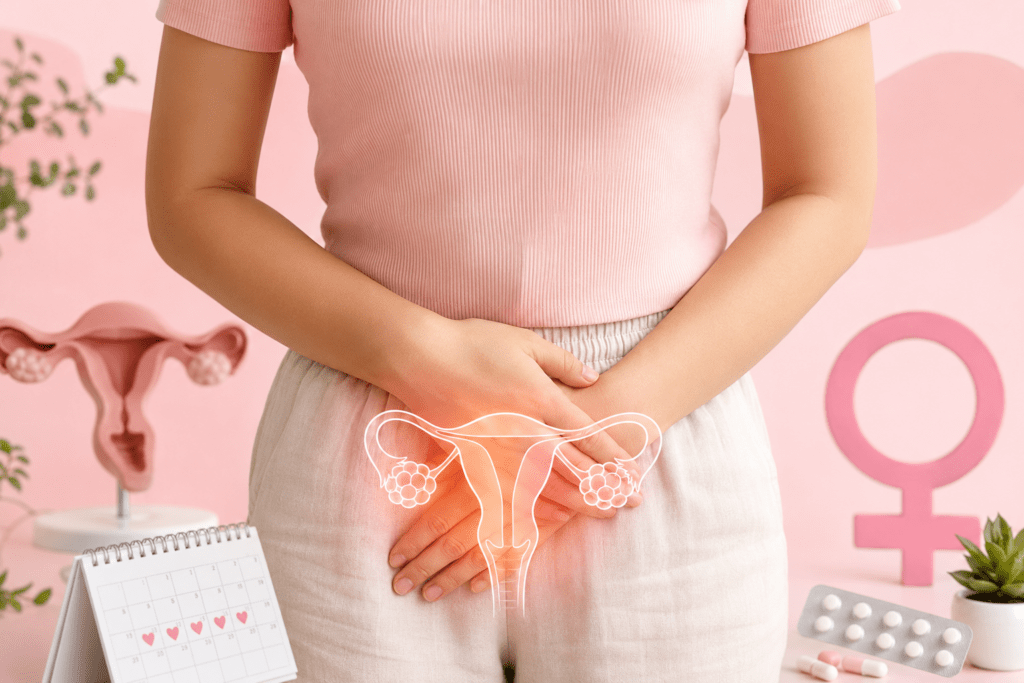
Here is where accuracy matters.
Medical experts and international organizations have been discussing renaming PCOS to better reflect what the condition actually involves.
One of the major outcomes of this work is the move toward:
Polyendocrine Metabolic Ovarian Syndrome (PMOS)
Let’s break that down in plain language.
Polyendocrine
This acknowledges that multiple hormone systems are involved….not just ovarian hormones.
Metabolic
This reflects the strong link between PCOS and metabolism, insulin resistance, blood sugar regulation, and long-term health risks.
Ovarian
Because the ovaries are still part of the condition.
Syndrome
Because it remains a collection of symptoms rather than a single disease with one cause.
Simply put:
The new terminology attempts to describe what women have been experiencing for years:
PCOS is bigger than cysts.
And bigger than ovaries alone.
Why This Name Change Matters More Than You Might Think
Let’s be honest.
Some people may hear this and think:
“Okay, but isn’t this just semantics?”
Not quite.
Because names shape healthcare.
A better name could mean:
Better understanding
Women may finally understand why symptoms like fatigue, insulin resistance, mood swings, or weight changes happen.
Better diagnosis
Doctors may begin looking beyond ovarian scans alone.
Better treatment
Healthcare may shift toward whole-body care instead of fertility-only treatment.
Less stigma
Many women have felt frustrated by how poorly understood PCOS can be.
A clearer name may reduce confusion and validate lived experiences.
And honestly?
For many women, validation matters.
Because living with symptoms that people dismiss can feel exhausting.
Symptoms of PCOS: What Women Commonly Experience
Even with a new name, the condition itself remains the same.
Symptoms vary widely, but common experiences include:
- Irregular or missed periods
- Difficulty ovulating
- Acne and oily skin
- Facial hair growth
- Hair thinning on the scalp
- Weight gain or difficulty losing weight
- Dark skin patches
- Fatigue
- Anxiety or depression
- Fertility challenges
However, here is something important:
Not every woman experiences all symptoms.
And that is one reason diagnosis can be so difficult.
Two women with PCOS may have completely different experiences.
Yet both are equally valid.
What Causes PCOS?

The honest answer?
Researchers still do not know one single cause.
Instead, experts believe that several factors work together.
Genetics
PCOS often runs in families.
If a mother or sister has it, risk increases.
Insulin Resistance
This is one of the strongest drivers.
When the body struggles to use insulin effectively, hormone production becomes disrupted.
That hormonal imbalance can interfere with ovulation.
Hormonal Imbalances
Higher androgen levels often contribute to symptoms like acne and excess hair growth.
Inflammation
Low-grade inflammation may also play a role in worsening symptoms.
As research evolves, experts increasingly view PCOS as a multi-system condition….which again explains the push toward a more accurate name.
How Is PCOS Diagnosed?
Doctors typically use the Rotterdam Criteria.
Diagnosis usually involves at least two out of three findings:
- Irregular ovulation
- Elevated androgen levels
- Polycystic ovaries on ultrasound
Blood tests may also help rule out thyroid conditions or other hormonal disorders.
Can PCOS Be Treated?
Yes…..although treatment looks different for everyone.
Management often includes:
- Lifestyle support
- Exercise
- Sleep improvement
- Nutrition changes
- Hormonal treatments
- Insulin-sensitizing medications
- Fertility support where needed
The goal is not perfection.
The goal is balance.
And for many women, symptom management improves significantly with consistency.
Where Fast Access to Medications Can Help
Managing a long-term condition like PCOS often requires more than motivation.
It requires consistency.
Whether it is remembering medications, staying on top of treatment plans, or building healthier routines, small actions add up over time.
That is where the myMedicines app can become a helpful companion. You should head to playstore or app store now to download!!
From medication reminders to trusted health information, having the right support system can make long-term management feel less overwhelming.
Because when it comes to PCOS, the journey is rarely about quick fixes.
It is about steady, sustainable care.
Sometimes, Changing a Name Changes Understanding
For years, many women have carried the weight of symptoms that did not always make sense.
They were told it was stress.
Weight.
Hormones.
Something to “just manage.”
But understanding evolves.
And medicine evolves too.
The conversation around the new name for PCOS reflects something bigger than terminology.
It reflects a growing recognition that women deserve healthcare language that accurately represents what they are living through.
Because a condition this complex deserves a name that tells the full story.
And perhaps, for millions of women worldwide, that story is finally beginning to be understood.
Frequently Asked Questions About the New Name for PCOS
The updated name increasingly being discussed is Polyendocrine Metabolic Ovarian Syndrome (PMOS).
Experts felt the old name did not accurately describe the condition, especially since many women do not have ovarian cysts.
No.Treatment remains based on symptoms and individual needs.
Yes. Many women diagnosed with PCOS do not have cysts on their ovaries.
PCOS is generally considered a lifelong condition, but symptoms can be effectively managed.
Yes. Many women with PCOS successfully conceive, sometimes naturally and sometimes with fertility support.
